
Knowing Who Handles Your Taxes Is Not the Same as Choosing Who Guides Your Business
Last month, we talked about the four financial roles every business owner should understand—andwhy knowing who does what creates clarity. This month, we are taking the next step.
Once you understand the roles surrounding your business, you can become more intentional about who you trust for financial guidance. For many business owners, that person is automatically their tax preparer. It makes sense. Your tax preparer knows your history, has reviewed your income and expenses, and may have worked with you for years. When a financial question comes up, they feel like the natural person to call. But preparing your tax return and helping you make ongoing business decisions are not necessarily the same service.
Your tax preparer may also provide tax planning, accounting, or advisory support. Many do. The important thing is not to assume those services are included simply because someone prepares your return. That is where intention begins.
From Clarity to Intention
Most business owners do not deliberately design their financial support system. They hire someone when a need appears. A tax deadline approaches, so they find a tax preparer. The books become difficult to manage, so they hire a bookkeeper. A major decision comes up, so they ask whichever financial professional is easiest to reach.
That approach may work for a while. But as the business grows, financial relationships need to become more intentional.
- The person who prepares your return may not be reviewing your cash flow throughout the year.
- The person explaining the tax impact of a purchase may not be evaluating whether the purchase makes sense for the business.
- And the person recording a decision may not be the person who should help you make it.
The goal is not to create a complicated financial team. It is to stop allowing familiarity or convenience to determine who guides your business.
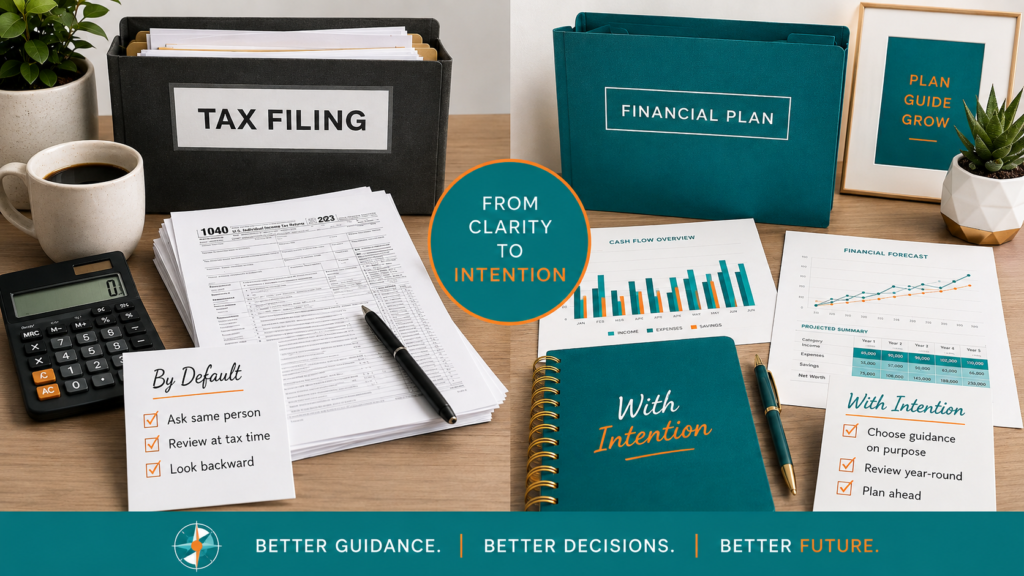
Financial Guidance by Default
- Asking the same person every financial question
- Assuming tax preparation includes year-round planning
- Reviewing the business only when tax season arrives
- Making decisions first and evaluating the impact later
- Assuming someone is monitoring the bigger picture
Financial Guidance by Intention
- Identifying the question before choosing who should answer it
Confirming which services are included
Reviewing financial information throughout the year
- Evaluating important decisions before making them
- Clearly assigning responsibility for planning and strategy
What Intentional Guidance Looks Like at Each Business Stage
Stage 1 · Clean Books Foundation: You need reliable records and clear financial responsibilities.
In the early years, financial decisions are often driven by deadlines.
Bookkeeping may be delayed until tax season, and the tax preparer may be the only financial professional involved. Because that person is already familiar with the business, they become the contact for every question.
Can I afford to pay myself more? Should I buy this equipment? Why is there less cash than I expected? The tax preparer may be able to answer some of these questions. But if they were hired only to prepare an annual return, they may not have current information or responsibility for the full decision.
At this stage, intention begins with understanding the relationship you already have.
What services are included? What information is being reviewed? What questions is this person responsible for helping you answer?
→ Focus: reliable records, clearer expectations, and understanding the support you currently have
Stage 2 · Monthly Money Insights: Your books are organized, but you need help interpreting the numbers.
At this stage, the bookkeeping may be current and taxes may be filed correctly. The business has
more structure, but the owner is still making important decisions alone. They have financial reports but are unsure what those reports mean for hiring, pricing, cash reserves, or future growth.
This is often where familiarity becomes confused with fit. The owner may value their tax professional, but the business now needs more proactive guidance than the original relationship was designed to provide.
That does not always mean replacing someone. It may mean asking whether tax planning is included. It may mean creating regular financial review meetings. Or it may mean adding an advisor who can interpret the numbers and help evaluate decisions throughout the year.
→ Focus: choosing guidance based on the business’s current needs rather than continuing by habit
Stage 3 · CFO-Level Growth: Your decisions require forecasting, scenario planning, and coordinated financial guidance.
As the business grows, decisions become more connected. Hiring affects payroll, capacity, and cash flow. Expansion affects overhead and risk. Pricing affects profitability and the company’s ability to grow.
Tax implications still matter, but they are only one part of the decision. At this stage, the business needs a coordinated financial support system. The tax professional provides tax expertise. The bookkeeper maintains accurate financial information. The fractional CFO helps the owner use that information to forecast, evaluate options, and plan ahead.
Intention means knowing who is responsible for each part of the financial picture—and making sure those professionals work together.
→ Focus: coordinated support, clear responsibilities, and forward-looking financial decisions
Looking at the Whole Decision
Imagine that you are considering a large equipment purchase before the end of the year. Your tax preparer may explain how the purchase could affect your return. That information is valuable. But a potential tax deduction does not automatically make the purchase a good business decision.
You may also need to ask:
- Does the business have enough cash?
- Will the purchase create pressure during a slower month?
- How long will it take to produce a return?
- Is financing or paying cash the better choice?
- Does the purchase support a clear business goal?
Your tax professional helps you understand the tax impact. Your CFO advisor helps you evaluate the broader business impact. The strongest decision considers both.
Tax Planning Is Not Business Planning
Tax planning helps you estimate obligations and prepare for tax payments. Business planning considers broader questions: Can the company afford another employee? Are prices producing healthy margins? How much cash should remain in reserve?
Taxes matter, but they are only one part of the financial picture. A purchase may reduce taxable income while creating a cash flow problem. Intentional guidance considers both the tax impact and the company’s long-term goals.
The Real Shift
The shift is not from one financial professional to another. It is from assumption to intention. It is the difference between saying:
“My tax preparer handles my finances.”
And saying:
“My tax professional helps with taxes. My bookkeeper keeps the numbers accurate. My advisor helps me use those numbers to make decisions.”
Most business owners do not need to replace everyone they currently work with. They need to understand what each relationship includes, identify what is missing, and decide whether their current support matches the business they are building.
Intention is not about adding more people. It is about making sure every important financial responsibility has a clear home.
Where NAVE Bookkeeping & CFO Advisory Group Fits In
At NAVE, we often meet owners who already have a trusted tax professional. They are not looking to replace that relationship. They are looking for the support that happens between tax seasons.
They need accurate financial information throughout the year. They need help understanding what the numbers mean. And they need guidance before making decisions about hiring, pricing, spending, or growth. That is where NAVE fits. Through bookkeeping, we create the reliable financial foundation needed for better decisions. Through CFO advisory, we help owners interpret their numbers, monitor cash flow, evaluate opportunities, and plan for what comes next.
We also work alongside tax professionals by helping ensure the information behind the tax return is accurate, organized, and useful throughout the year. The goal is not to compete with your tax preparer. It is to make tax guidance part of a larger, intentional financial support system.
The Clarity Check
A few quick questions:
- Do you know exactly which services your tax preparer provides?
- Are you receiving tax preparation, tax planning, or both?
- Who reviews your cash flow throughout the year?Who helps you evaluate financial decisions before you make them?
- Are you asking someone for guidance because they are the right advisor—or because they are familiar?
- Has your financial support changed as your business has grown?
- Is anyone helping connect the different parts of your financial picture?
You do not need a complicated financial department. But you should know who helps you understand the past, manage the present, and prepare for the future. That is what intentional financial support looks like.
Book Recommendation
Simple Numbers, Straight Talk, Big Profits — Greg Crabtree
Many business owners have financial information available to them but are not always sure which numbers deserve their attention—or who should help them interpret those numbers.
In Simple Numbers, Straight Talk, Big Profits, accountant Greg Crabtree explains the financial indicators that matter when building a healthy and profitable business. He encourages owners to look beyond revenue and tax returns and pay closer attention to areas such as profitability, labor efficiency, cash flow, and owner compensation.
That message connects directly to this month’s theme of intention. Your tax preparer can help you understand your tax obligations, but making decisions about pricing, hiring, profitability, and growth requires a broader view of the business. The book reinforces an important idea: having numbers is not enough. You need to know which numbers matter, what they are telling you, and who is helping you use them to make better decisions.
Straightforward guidance. Numbers you can use.
Final Thought
Your tax preparer may be an important and trusted member of your financial team. But that relationship should not become the answer to every financial need simply because it is familiar. Do not let convenience build your financial support system for you. Choose your advisors on purpose. Clarify their responsibilities. And make sure the support surrounding your business matches where you are trying to go.
Are You Making Financial Decisions Without Ongoing Guidance?
Your tax return can show what happened in the past. It cannot, on its own, tell you whether you are ready to hire, how much cash you should reserve, whether your pricing is sustainable, or what your next stage of growth should look like.
NAVE Bookkeeping & CFO Advisory Group helps business owners build an intentional financial process throughout the year. We can help you understand the support you currently have, identify what is missing, and use your numbers to make more confident decisions.
Are you unsure who should be helping with your next financial decision?
Schedule a complimentary Financial Clarity Call with Nave. We will help you understand the support you currently have, identify what may be missing, and determine the right next step for your business.
NAVE Bookkeeping & CFO Advisory Group — Guiding businesses through every stage of growth with expert financial foundations and CFO-level insight.
Frequently Asked Questions
Can a tax preparer also provide business advice?
Yes. Some tax preparers and CPAs offer year-round business advisory services in addition to preparing tax returns. The important question is whether business planning is included in the professional’s services. Business owners should understand who is responsible for tax compliance, bookkeeping, cash-flow guidance, and forward-looking planning.
What is the difference between tax planning and CFO planning?
Tax planning focuses on managing tax obligations and understanding the tax impact of financial decisions. CFO planning looks at the business more broadly, including cash flow, profitability, pricing, hiring, forecasting, and growth. These services complement each other: tax planning considers the tax consequences, while CFO planning evaluates how a decision supports the company’s overall financial goals.
When does a business need a fractional CFO?
A business may benefit from a fractional CFO when its books are reliable but the owner needs help using the numbers to make decisions. Common signs include unpredictable cash flow, shrinking margins, plans to hire or expand, and uncertainty about what the business can afford. A fractional CFO provides strategic financial guidance without the cost of hiring a full-time CFO.